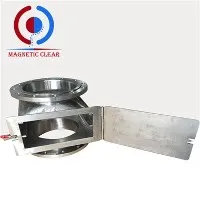
how magnetic separator works
Oct 10, 2023
how magnetic separator works
Magnetic separators are essential tools in the process of separating magnetic materials from non-magnetic ones. They use the power of magnets to attract and separate metallic substances from other materials.
The principle behind the functioning of a magnetic separator is very simple. Its construction consists of a series of powerful magnets that are placed around a magnetized drum. When the material to be separated passes through the drum, the magnetic particles are attracted to the magnetic field created by the magnets. The magnetic force exerted by the magnets is strong enough to pull and separate the magnetic particles from the non-magnetic ones.
The efficiency of a magnetic separator depends on the strength of the magnetic field. The stronger the magnetic field, the more efficient the separation process will be. Therefore, the design of a magnetic separator is optimized to generate a maximum magnetic field without compromising on the overall performance.
Magnetic separators are widely used in a variety of industries, including mining, recycling, food processing, and pharmaceuticals. They are capable of separating a wide variety of magnetic metals, including iron, nickel, cobalt, and many others.
Overall, magnetic separators are an excellent tool for separating magnetic and non-magnetic materials. They are easy to use, efficient, and effective, making them a valuable asset to any operation that requires the separation of magnetic materials.
Magnetic separators are powerful and efficient tools used in a variety of industries to separate magnetic objects from non-magnetic materials. The technology behind magnetic separation is simple yet effective, making it a popular method of separating materials for recycling, mining, and many other applications.
The basic principle of magnetic separation involves the use of magnetic fields to attract and separate magnetic materials from non-magnetic ones. The process begins with the application of a strong magnetic field to a mixture of materials. As the mixture passes through the magnetic field, the magnetic components are attracted to the magnetic field and separated from the non-magnetic material.
Magnetic separators come in a variety of configurations and designs, each tailored to specific applications. Some magnetic separators use permanent magnets, which generate a continual magnetic field, while others use electromagnets, which can be turned on and off to create a pulsating magnetic field. The strength and intensity of the magnetic field also vary depending on the specific application.
Magnetic separators are widely used in mining and mineral processing, recycling, and bulk handling industries, where they can separate ferrous and non-ferrous materials. In mining, magnetic separators are used to recover valuable minerals that have been separated from the ore during process. In recycling industries, magnetic separators are used to remove impurities and contaminants from recyclable material before further processing.
One of the key advantages of magnetic separation is its ability to separate materials with very low magnetic susceptibility. This means that even materials that are only slightly magnetic can be separated from non-magnetic materials with relative ease. Magnetic separation is also a clean and environmentally friendly process, as it uses a magnetic field to separate materials without the need for any chemicals or harmful substances.
In conclusion, magnetic separators are essential tools in a wide range of industries, providing an efficient and effective method of separating magnetic and non-magnetic materials. From mining to recycling, magnetic separation has proven to be an indispensable technology that offers numerous benefits, including increased efficiency, cost savings, and environmental sustainability.